
Updated July 29, 2026
At first glance, AI agent vs custom GPT sounds like a technical debate. For most organizations, it’s actually a question of how work gets done and how AI fits into daily operations.
Key takeaways
An AI agent takes action for you, deciding what to do next and executing tasks across systems on its own. A custom GPT does not act independently; it answers questions and drafts content while a person makes the final call. The right choice depends on responsibility, not intelligence.
- AI agents execute tasks and adapt to outcomes across systems; custom GPTs assist people but never act independently.
- Custom GPTs are faster and lower-risk to deploy because a person approves every output; AI agents need governance, monitoring, and escalation paths because they act inside live systems.
- Choose a custom GPT when the goal is better information, consistency, or speed on well-defined tasks.
- Choose an AI agent when work spans multiple systems, tools, or teams and needs to move without constant handoffs.
- Only 17% of organizations have deployed AI agents so far, though more than 60% plan to within two years, so most companies are still deciding, not behind (Gartner, 2026).
Both approaches are built on modern artificial intelligence, drawing from large language models, generative AI, and a growing ecosystem of AI tools. AI agents are designed to take action and execute tasks across systems. Custom GPTs are designed to provide guidance, structure information, and assist human users without operating independently.
This article breaks down what each approach really is, how they work in practice, and what business and technical leaders should consider before choosing one as part of a broader AI solution.
What Is an AI Agent?
At its core, what an AI agent is comes down to action. An AI agent is designed to operate within AI systems, make decisions, and carry out work across real business processes.
Unlike traditional AI tools or conversational AI assistants, AI agents are built to pursue goals. They can evaluate inputs, choose next steps, and adapt their behavior based on outcomes. This is why they are often described as intelligent agents or autonomous agents. However, unlike human agents, who rely on judgment and experience, AI agents are designed to follow defined goals and act within systems based on data and rules.
Modern agent technology typically combines artificial intelligence, large language models, and machine learning techniques to interpret information, identify patterns, and determine what to do next. In practice, organizations expect AI agents to go beyond recommendations and actually move work forward by coordinating tasks and contributing directly to execution.
How Do AI Agents Work?
At a basic level, an agent follows a loop: it receives information, evaluates possible actions, and decides what to do next. This reasoning process and decision-making capability is what allows an agent to act rather than simply respond.
Most modern agents combine large language models, AI models, and other machine learning techniques to interpret inputs, maintain an internal model of the task at hand, and determine appropriate actions. They can draw on past interactions, maintain context over time, and adjust their behavior based on outcomes. This makes them suitable for dynamic environments that change.
Where agents become truly operational is in how they connect to the world around them. Through external tools and external systems, an agent can retrieve data and coordinate with other software. This allows a single agent, or multiple agents working together, to move through complex workflows and carry out work that spans departments and platforms.
When Does an AI Agent Make Sense for the Business?
Building AI agents is most valuable when work involves more than answering questions. Different types of AI agents are suited to different operational needs, from simple coordination to full workflow orchestration. In general, AI agents work well when they must move across systems, adapt to changing inputs, and carry responsibility for outcomes.
This is especially true for complex tasks that span multiple steps, tools, or teams. When organizations need to automate complex tasks, manage complex workflows, or coordinate actions across platforms, AI agents provide the structure to keep work moving without constant handoffs.
Agents are also effective when the goal is to reduce manual overhead. By handling routine tasks and helping to automate routine tasks, they free teams to focus on higher-value work. In more advanced use cases, multiple AI agents can be organized into multi-agent systems, where multiple specialized agents divide responsibilities and work together as compound AI systems.
What Is a Custom GPT?
If an AI agent is designed to act, a custom GPT is designed to assist. At its core, a custom GPT is defined by configuration. It is a tailored version of a language model, shaped by instructions, examples, and context so it behaves in a specific, predictable way.
Custom GPTs are built on large language models and use natural language processing to generate responses that align with a defined purpose. Unlike agents, they do not operate across systems or take responsibility for outcomes. Instead, they function as focused AI assistants that organize information, answer questions, and support human users inside clearly defined boundaries.
In practice, organizations use custom GPTs to standardize knowledge, improve consistency, and make expertise more accessible across teams. They can be tuned to reflect internal language, policies, or workflows, making them more useful than general-purpose chat tools without introducing the complexity of autonomous behavior.
How Do Custom GPTs Work in Practice?
While AI agents are built around action, custom GPTs are built around structure. They are configured by defining instructions, examples, and boundaries that guide how the model interprets requests and produces responses. This allows a custom GPT to consistently follow tone, policy, or domain-specific rules without needing to make independent decisions.
At the technical level, custom GPTs rely on large language models and natural language processing to understand intent and generate relevant output. They can reference prior messages to maintain context, but their behavior remains constrained by how they are configured. They do not evaluate options, trigger processes, or interact with external systems on their own.
In day-to-day use, this makes custom GPTs effective for well-defined specific tasks: summarizing information, answering internal questions, drafting content, or standardizing communication. They respond to prompts from human users, providing fast access to knowledge without introducing operational risk.
When Is a Custom GPT the Right Tool?
A custom GPT is the right choice when the goal is to support people rather than replace processes. It works best in situations where tasks are clearly defined, low risk, and centered on information rather than execution.
This is especially true for routine tasks and repetitive tasks that involve language, documentation, or internal knowledge. Organizations often use custom GPTs to automate repetitive tasks such as summarizing reports, answering common questions, or drafting standard responses for customer support inquiries. In these cases, the model helps teams perform tasks more efficiently without taking on responsibility for outcomes.
Custom GPTs are also well suited for bounded workflows where accuracy, consistency, and control matter more than autonomy. They can help complete tasks that rely on structured inputs while keeping decision authority with human users.
AI Agent vs Custom GPT: What’s the Real Difference?
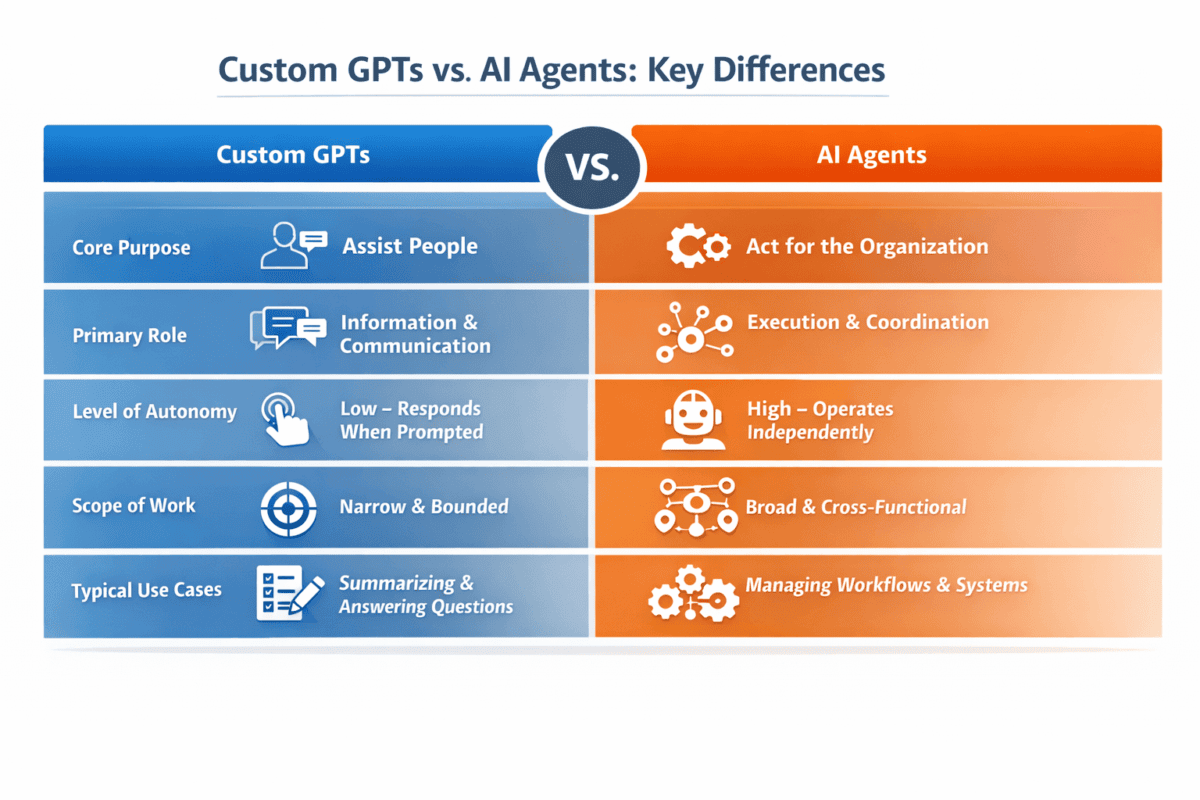
At a structural level, AI agent vs custom GPT is more a question of responsibility than intelligence. Both rely on artificial intelligence and large language models, but they are designed for fundamentally different roles inside AI systems.
An AI agent offers a way to control operations and take autonomous action. It can interpret information, decide on next steps, and take action through external tools and external systems. Unlike other agents or traditional automation tools, an AI agent is accountable for outcomes and can adapt its actions based on context. It may coordinate workflows, move data, or trigger processes, all while adapting to changing conditions. This is why agents can perform complex tasks and function directly inside core business processes.
A custom GPT, by contrast, is built to inform. It does not act on the world or initiate outcomes. Instead, it responds to prompts from human users, organizes information, and supports analysis. Control remains explicit: decisions are made by people, not by the system. This makes a custom GPT easier to govern, but also limits what it can do without human intervention.
Comparison at a Glance
| AI Agent | Custom GPT | |
|---|---|---|
| What it does | Acts independently: executes multi-step tasks across systems | Responds to prompts: answers, drafts, and organizes information |
| How it works | Combines LLMs with external tools and systems in a decide-then-act loop | Configured with instructions, examples, and uploaded knowledge inside a chat interface |
| Best for | Cross-system workflows, high-volume coordination, adaptive processes | Bounded, well-defined tasks: summarizing, drafting, answering internal questions |
| Deployment speed | Slower; more engineering and governance setup | Fast, often no-code, live in hours or days |
| Oversight required | High: ongoing monitoring, audit trails, escalation paths | Low: a person stays in the loop by design |
| Who it’s for | Teams ready to shift execution responsibility into software | Teams that want faster, more consistent access to information |
What Are the Advantages and Disadvantages of AI Agents?
AI agents are designed for action. They enable organizations to automate work that spans systems and adapts to changing conditions. In more mature environments, sophisticated AI agents can coordinate across multiple systems.
Advantages of AI Agents
- Can handle complex work: AI agents are well suited to tackle complex tasks that involve multiple steps, tools, or teams.
- Operational automation: When organizations deploy AI agents, they can reduce manual coordination across workflows, approvals, and data movement.
- Customization for business needs: Advanced AI agents and custom AI agents can be tailored to specific operational rules and processes.
- Efficiency at scale: By reducing handoffs and delays, agents can lead to significant cost savings in high-volume or process-heavy environments.
- Better execution: Unlike advisory tools, agents take responsibility for their actions, helping work actually move forward.

Disadvantages of AI Agents
- Governance and oversight requirements: Because agents act inside live systems, their behavior must be monitored, audited, and controlled, especially when using AI agents across critical workflows. Platforms built for this, like Faye’s Airia, give teams a single view into every agent running across the business.
- Risk of unintended actions: Without clear boundaries, agents can misinterpret context or act too quickly in situations that still require human judgment.
- Operational complexity: Designing escalation paths, exception handling, and oversight adds engineering and process overhead.
- Not suitable for immature processes: In organizations without strong governance or clearly defined workflows, agents can increase complexity rather than reduce it.
What Are the Advantages and Disadvantages of Custom GPTs?
Custom GPTs are designed to support people, not replace processes. They make information easier to access and work with, but they are intentionally limited in what they can execute or control.
Advantages of Custom GPTs
- Low-risk assistance: A custom GPT operates within clear boundaries, making it easy to deploy without introducing operational risk.
- Efficiency for everyday work: Organizations use custom GPTs to streamline routine tasks and repetitive tasks.
- Consistency and standardization: By encoding tone, policy, and internal language, custom GPTs help standardize communication and knowledge across teams.
- Rapid time to value: Because they do not require deep system integration, custom GPTs can be deployed quickly as practical AI tools or AI assistants.
- Human-centered control: Decisions remain with human users, making custom GPTs well suited for environments where accuracy, accountability, and governance matter.
Disadvantages of Custom GPTs
- No execution capability: A custom GPT cannot act on the world. It does not trigger workflows, move data, or execute tasks inside operational systems.
- Limited to bounded use cases: They are best suited for specific tasks and structured workflows, not for work that requires orchestration across systems.
- Dependence on human input: Because they only respond to prompts, they require ongoing direction from human users to be effective.
- Not built for complex operations: In environments that demand automation of multi-step or adaptive processes, custom GPTs lack the autonomy needed to replace manual coordination.
AI Agent vs Custom GPT: Which Is Right for Your Organization?
Choosing between an AI agent and a custom GPT is about evaluating how your organization works today, what level of automation you actually need, and how much operational responsibility you are prepared to shift into software.
When to Use a Custom GPT
- The primary goal is improving how people access, understand, and use information.
- You need to standardize answers, accelerate analysis, or support documentation and internal knowledge.
- You want to enhance decision-making without changing who owns execution.
- Workflows are well defined and centered on communication, training, or customer interactions.
- Your organization wants fast value with minimal disruption and full control remaining with human users.
When to Use an AI Agent
- Your organization needs automation that operates across systems.
- Work involves interconnected business processes rather than isolated tasks.
- You want software that can adapt to changing inputs and carry responsibility for outcomes.
- Operations are already structured, governed, and ready for deeper automation.
- You are prepared to manage oversight, escalation, and risk as part of production AI systems, especially when interacting with customer data or critical platforms.
The key question is what your organization is ready to govern in practice. Leaders who make informed decisions here tend to start with the level of autonomy they are comfortable with.
Not Sure Which Approach Fits? Talk It Through With Faye
UNLOCK YOUR FREE 1-HOUR AI CONSULTATION
Discover how AI can transform your business with a personalized session tailored to your goals. This 1-hour consultation dives into practical ways to elevate customer experience, operations, and ROI.
- Identify high-impact AI use cases for your business
- Explore tools to optimize CX, lead flow, and revenue
- Get expert insights on automation and AI strategy
 Book Your Consultation
Which Should You Choose?
The distinction between an AI agent and a custom GPT is not about which technology is more capable. It is about how much responsibility your organization is ready to place into software.
Custom GPTs improve how people work with information. AI agents change how work itself gets done. What matters most is alignment: with your business processes, your risk tolerance, and your long-term goals for AI inside the organization.
Leaders who take this architectural view, rather than chasing tools, are better positioned to build AI solutions that scale, integrate, and deliver real value over time. For those who prioritize control, governance, and human-led decision-making, a custom GPT offers a practical way to add AI without introducing operational risk.
For organizations ready to move from experimentation to execution, Faye works with teams to integrate AI into real business systems, from evaluating an AI agent against a custom GPT to building and governing whichever approach fits. Schedule a conversation with Faye’s AI team.
Frequently Asked Questions
What’s the difference between an AI agent and a custom GPT?
An AI agent acts. It makes decisions and executes tasks across systems without waiting for a person to approve each step. A custom GPT assists. It answers questions, drafts content, and organizes information, but a human always makes the final call. The real difference is responsibility, not intelligence.
Can a custom GPT take actions the way an AI agent does?
Not on its own. A custom GPT is built to respond to prompts, not to trigger workflows or reach into other systems independently. Some platforms add custom actions that let a GPT call an API, but a person still starts and reviews the interaction, which keeps it fundamentally different from an autonomous agent.
Do most organizations need both an AI agent and a custom GPT?
Many organizations end up using both, just for different jobs. A custom GPT handles bounded, information-heavy tasks like drafting or answering internal questions, while an AI agent takes on cross-system work like moving data or coordinating approvals. Choose based on the task in front of you, not a single company-wide standard.
What’s the biggest risk of deploying an AI agent?
Acting on incomplete or incorrect context before a person catches it. Because agents operate inside live systems, an unclear boundary can let them misread a situation or move too fast on something that still needs human judgment. Strong governance, monitoring, and clear escalation paths reduce this risk substantially.
How do I know if my organization is ready for an AI agent?
Readiness is about governance more than technology. If your workflows are already documented and you have a plan for oversight, audit trails, and escalation, you are likely ready. If processes are still inconsistent or undocumented, a custom GPT or a manual process is the safer place to start.


Financial services support has a specific tension baked into it that most other industries don't deal with in the same Read more

Every AI support vendor’s sales pitch sounds like it applies to every business. It doesn’t. Fin is a genuinely strong Read more

Companies moving from a traditional ticketing model to an AI-first support approach almost always scope the project as a technology Read more

Every AI support agent eventually has to say no to something, or hold firm on a policy the customer doesn’t like. How Read more