
And that’s not an adoption failure. It’s the end of an era; the start of a much better one.
It’s 9:50 in the morning. One of your reps is parked outside a client’s office, ten minutes early for a meeting that matters. They open a chat window on their phone and type: “Brief me on this account before I go in.”
Back comes everything. Where the pipeline stands. The two open quotes nobody has chased. The fact that the last three conversations were all with procurement, not the decision-maker. The rep reads it, pockets the phone, and walks in genuinely prepared.
Forty-five minutes later they walk out. Before the engine’s even running, they talk into the same chat: “Good meeting. Dave wants the extended warranty on the renewal. He’s worried about lead time on the X300. Log it, and flag the lead-time concern to ops.”
Done. A meeting record, created and linked to the right account and contact. The opportunity updated. A task raised for operations. All of it captured while it’s still fresh.
Your rep never opened your CRM. And for this, they never will again.
That isn’t a vision of a few years from now. We built it. It works today.
Key Takeaways
- Faye has built an MCP server for SugarCRM that lets an AI assistant like Claude read from and write to Sugar in plain English, doing the work of the screen without the screen.
- It runs on Sugar’s REST API with more than thirty tools, works on cloud or on-premise Sugar, and asks for confirmation before deleting anything.
- In a live demo, it briefed a rep on an account before a meeting, then logged the full outcome afterward, all without opening Sugar.
- The CRM adoption problem was never really about lazy salespeople; it’s the interface asking too much at exactly the wrong moment.
- Faye is opening a small pilot programme for companies that want to see this workflow run against their own Sugar data.
What Did Faye Actually Build?
Faye’s team has built a wide-ranging MCP server for SugarCRM. An MCP is the connective tissue that lets an AI assistant like Claude reach into a system and do real work in it, using the open Model Context Protocol, properly and safely, not screen-scraping.
Ours sits on Sugar’s REST API, so it does very nearly anything Sugar can: search across modules, create and update and link records, read audit history, run the sort of cross-module analysis you’d normally build a report for. More than thirty tools, on cloud or on-premise Sugar, with guardrails that make it ask before it deletes anything.
It is, in effect, a headless Sugar. Your CRM with no screen to log into, doing what you ask in plain English.
What Does This Look Like in Practice?
Remember the rep in the car? Here’s that exact workflow, run live against Sugar. (Demo account: “Northwind Traders.”)
Before the call, I asked for a briefing in a single question, what’s in the pipe, who we know, and what we last covered:
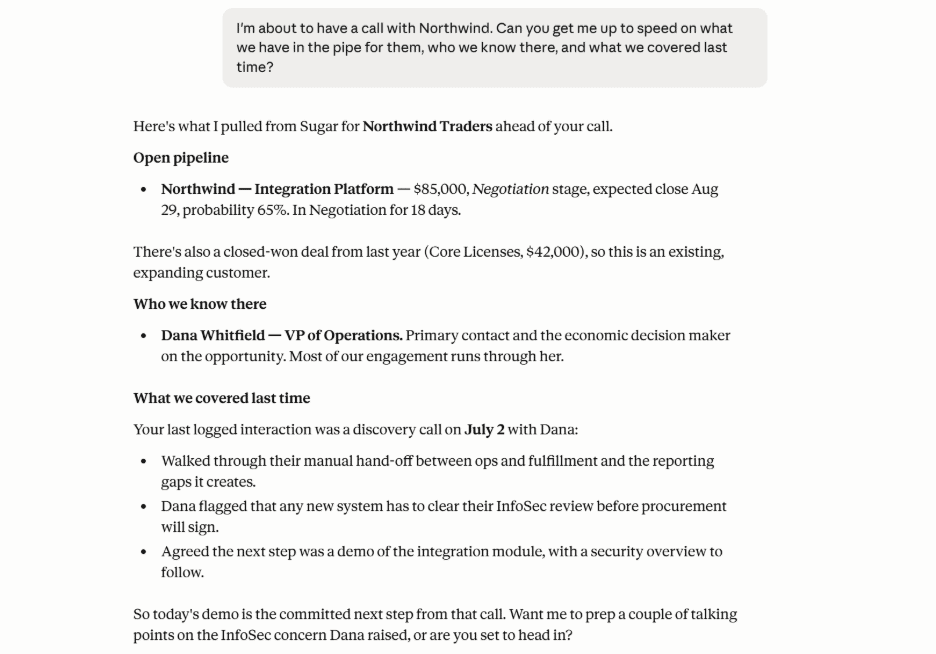
Everything you need to walk in sharp, pulled from the CRM and read back in plain English.
After the call, I logged it by talking, not typing into forms. This is the prompt I put back in: “Demo went well. Attendees were the VP of Ops and a new IT lead, Jamie Chen, who we met for the first time. Next step is a security review. Log the meeting, create a contact for Jamie, and link her to the account and the opportunity.”
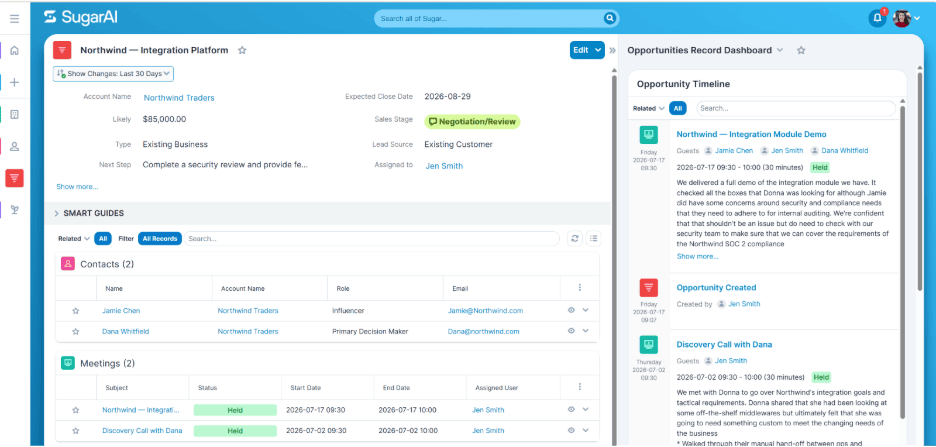
Here’s what it did with that:
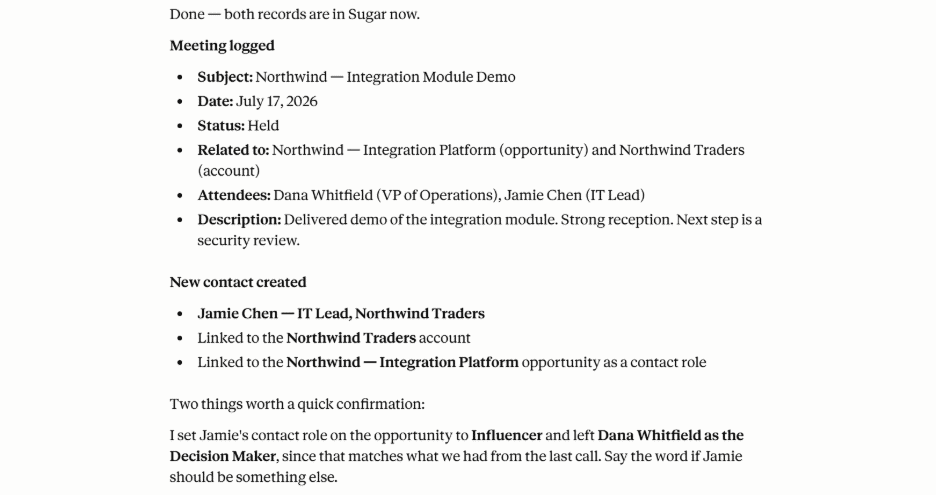
No navigating. No forms. No “I’ll update Sugar later” that never happens.
Why Do Salespeople Really Stop Using Their CRM?
I’ve spent most of two decades helping companies get their people to actually use their CRM. Training. Gamification. Management pressure. Process gates. Some of it helps. None of it has ever truly solved the problem.
Here’s what I’ve come to believe: it was never that salespeople are lazy. It’s that the interface asks too much of them, at exactly the wrong moment. You can force the hard data in; make it impossible to close a deal without the details. But everything before the close (the meeting notes, the read on how a customer feels, the half-formed upsell idea) is the soft, high-value stuff. And it’s exactly what dies in the car park, because opening the app and typing it all up is friction nobody wants after a long day.
Take the interface away and the friction goes with it. A rep who can simply talk (“here’s what happened, log it”) captures ten times more than one who has to find the account, open the meeting, and type into a form.
That creates something we’ve never had: a virtuous cycle. Less effort in means more data in. More data in means sharper insights out. Sharper insights make the next briefing genuinely useful, which makes the rep want to keep feeding it. The adoption problem doesn’t get managed. It largely dissolves.
Is Your Business Ready for a Headless CRM?
Most businesses aren’t ready for a rep who never logs in. Some of your people will love it; some will be uneasy at an AI touching their records. That caution is sensible. This is a real shift, and shifts like this need a guide.
That’s where we come in. Faye can meet you wherever you are on the curve, from a plain-English query you run when you feel like it, all the way to the fully headless workflow in that car, with the right guardrails and honest advice about what your organisation is ready for today.
We’ve built the future of working with Sugar. The interesting question is how far into it you’d like to go.
Curious to see it against your own data? We’re opening a small pilot programme.
Get in touch, or, fittingly, just ask.
Frequently Asked Questions
What is an MCP server for SugarCRM?
An MCP is the connective tissue that lets an AI assistant like Claude reach into a system and do real work in it, properly and safely, not screen-scraping. Faye’s MCP server sits on Sugar’s REST API, so the assistant can search, create, update, and link records, and run cross-module analysis from plain English.
Can an AI assistant safely update CRM records?
Yes, with guardrails. Faye’s MCP server asks for confirmation before it deletes anything, so nothing destructive happens without a check first. It works through Sugar’s standard REST API rather than screen-scraping, and reads Sugar’s own audit history rather than bypassing it.
Does it work with on-premise Sugar or only cloud?
Both. Faye’s MCP server works on cloud or on-premise Sugar, with more than thirty tools covering search, record creation, updates, linking, and cross-module analysis; it does very nearly anything the Sugar interface can, running the same guardrails wherever your instance lives.
What does a headless CRM actually mean?
A headless Sugar is your CRM with no screen to log into, doing what you ask in plain English. The database, the logic, and the records stay exactly where they are; only the requirement to open an interface and click through forms goes away.
How can we try this?
Faye is opening a small pilot programme for companies that want to see this workflow run against their own Sugar data. Get in touch, or, fittingly, just ask, and Faye can walk through what that would look like for your team.


You're looking to extend Salesforce's capabilities, to build a product that lives within the ecosystem and solves a real problem for Read more

Tools like Sugar offer powerful capabilities. However, poor adoption can limit the impact of even the most advanced CRM platform. Read more

Salesforce is one of the most powerful CRM platforms available today, offering a wide range of tools to manage sales, Read more

Companies running NetSuite depend on accurate customer data and streamlined workflows to manage daily operations. Whether you're managing sales or Read more