
AI is rapidly reshaping how organizations operate. As new artificial intelligence solutions emerge, companies are under pressure to deploy AI in ways that drive meaningful outcomes.
However, increased usage does not always translate into clarity or value. A 2025 Gallup employee survey found that while 44% of organizations have begun AI adoption, only 22% have communicated a clear plan or strategy for using it. The result is a growing challenge across industries as AI usage outpaces governance and execution.
This is where experienced AI consulting firms can help. The best AI consulting companies provide strategic guidance, uncover high-impact use cases, and align AI initiatives with existing systems and business processes. This article outlines how to evaluate AI consulting partners and choose a provider that can support sustainable adoption and facilitate a long-term business transformation.
What Is an AI Consulting Partner
An AI consulting partner helps organizations apply artificial intelligence to real business challenges. The best AI consulting firms work closely with leadership and teams to identify where AI can improve business processes, integrate with existing systems, and support measurable outcomes.
What distinguishes effective artificial intelligence consulting is context. AI does not operate in a vacuum. To deploy AI successfully, a consulting partner must understand how data flows across the organization, how teams use systems like CRM and CX platforms, and how decisions are made day to day.
Unlike transactional vendors, strong AI consultancies provide ongoing advisory services, helping organizations make informed decisions rather than simply delivering one-off implementations. They push back when needed, ask difficult questions, and help organizations clarify what they are trying to achieve before proposing solutions.
Why Companies Hire AI Consulting Firms
Organizations turn to AI consulting firms when interest in artificial intelligence is high, but internal direction is unclear. Leaders may recognize the potential of AI solutions, yet struggle to identify where the technology can lead to significant improvements in measurable business outcomes.
In many cases, teams have begun experimenting with machine learning or natural language processing tools without a clear direction. Without strategic guidance, adoption often becomes reactive and focused on isolated use cases rather than meaningful improvements to business processes or operational efficiency.
The best AI consulting companies help organizations combine technical capabilities and expertise with a deep understanding of how businesses operate. A strong consulting partner aligns AI adoption with real-world workflows and data. Their role is not simply to deploy technology, but to ensure AI initiatives support measurable business growth and deliver outcomes that matter to both leadership and frontline teams.
When Should You Consider an AI Consulting Partner?
Organizations often consider working with AI consulting firms when curiosity about artificial intelligence begins to outpace internal confidence. Leadership may sense that AI can improve performance, but lack clarity on where to start or how to proceed responsibly.
This moment typically arrives when early AI adoption efforts feel unstructured. Teams may be testing tools independently, exploring generative AI, or automating small tasks, yet without a shared strategy or clear ownership. As experimentation grows, so do concerns around integration, data quality, and long-term sustainability.
An experienced AI consulting partner becomes especially valuable when organizations want to move from isolated trials to coordinated action. The best AI consulting firms help assess readiness and identify high-impact opportunities. Rather than rushing implementation, they provide strategic guidance that aligns AI initiatives with existing systems and business needs.
What Industries Benefit Most From AI Consulting?
AI consulting is not limited to a single sector. In practice, organizations across various industries can benefit from applying artificial intelligence to improve efficiency and decision-making.
The common thread is not industry type, but the presence of complex systems, data, and workflows that can be enhanced through thoughtful AI adoption. This can benefit a range of industries and business types including financial service, software development companies, life science, manufacturing, and health care.
UNLOCK YOUR FREE 1-HOUR AI CONSULTATION
Discover how AI can transform your business with a personalized session tailored to your goals. This 1-hour consultation dives into practical ways to elevate customer experience, operations, and ROI.
- Identify high-impact AI use cases for your business
- Explore tools to optimize CX, lead flow, and revenue
- Get expert insights on automation and AI strategy
 Book Your Consultation
What to Look for in the Best AI Consulting Firms
Not all AI consulting firms are equipped to deliver lasting value. The difference between short-lived experimentation and meaningful results often comes down to how a consulting partner approaches strategy, execution, and integration.
When evaluating the best AI consulting companies, several qualities consistently separate strong partners from risky ones.
Breadth of Expertise Beyond AI
Effective artificial intelligence consulting requires more than familiarity with models or tools. A strong partner understands how AI fits within existing technology environments, including CRM, CX, ERP, and core data systems. Without this context, even well-built digital solutions struggle to integrate with real business processes.
The strongest firms bring a dedicated team with experience delivering complex technology solutions, rather than relying on isolated specialists or temporary resources.
A Business-First Mindset
The best AI consulting firms work towards outcomes. They begin by understanding business objectives, operational constraints, and how teams actually work. Rather than trying to deploy AI driven solutions for their own sake, they focus on supporting clients by aligning tailored solutions with measurable improvements.
Willingness to Push Back
Strong AI consultants are not order-takers. They challenge assumptions, ask why certain solutions are being requested, and help reframe problems when needed. This advisory approach ensures AI initiatives support the organization’s broader business model, rather than reinforcing existing inefficiencies.
Experience Enabling Teams
Sustainable AI adoption depends on people as much as technology. Leading consulting partners provide AI training, workshops, and hands-on guidance that help teams understand what AI can (and cannot do). This reduces resistance and accelerates adoption across business functions.

Proven Ability to Deliver Measurable Outcomes
The best AI consulting firms tie their work to clear results. Whether the goal is improving operational efficiency, enhancing customer satisfaction, or driving business growth, strong partners define success early and track progress over time.
Why AI Consulting Requires Deep Understanding of CRM, CX, and Business Systems
AI delivers value only when it operates within the reality of how a business runs. This is why effective AI consulting demands a deep understanding of both AI technology and the systems that power daily operations.
Most organizations rely on interconnected platforms such as CRM systems, CX and ticketing tools, financial databases, and operational workflows. These systems define how data is captured and acted upon. Without familiarity with these environments, AI solutions risk being disconnected from the processes they are meant to improve.
Strong AI consulting firms understand that AI must integrate directly with existing business processes and proprietary data. This includes knowing how sales data flows through CRM platforms, how customer interactions are managed in CX systems, and how information moves across departments. When AI is layered on top of these systems without context, outcomes often fall short.
The best AI consulting companies treat integration as a core competency. By grounding AI initiatives in real workflows and existing technology stacks, they help organizations deploy AI in ways that are aligned with long-term digital transformation goals.
Red Flags When Choosing an AI Consulting Company
As interest in AI adoption grows, so does the number of providers offering AI consulting services. Not all approach the work with the same level of rigor. Identifying red flags early can help organizations avoid wasted effort.
Leading With Tools Instead of Understanding the Business
One common warning sign is an AI consulting company that proposes AI development or generative AI solutions before taking time to understand the organization’s workflows, data, and goals. When tools come first, AI initiatives often optimize for speed rather than impact.
Acting as Order-Takers Rather Than Advisors
Effective AI consultants challenge assumptions and ask difficult questions. Firms that simply build what they are asked for, without exploring whether those requests align with real business needs, often deliver solutions that fail to improve business processes or create meaningful value.
Skipping Education and Enablement
Sustainable AI adoption depends on more than technology. Consulting partners that downplay training, workshops, or ongoing support leave teams unprepared to use AI systems effectively. Over time, this leads to underutilized tools and stalled momentum.
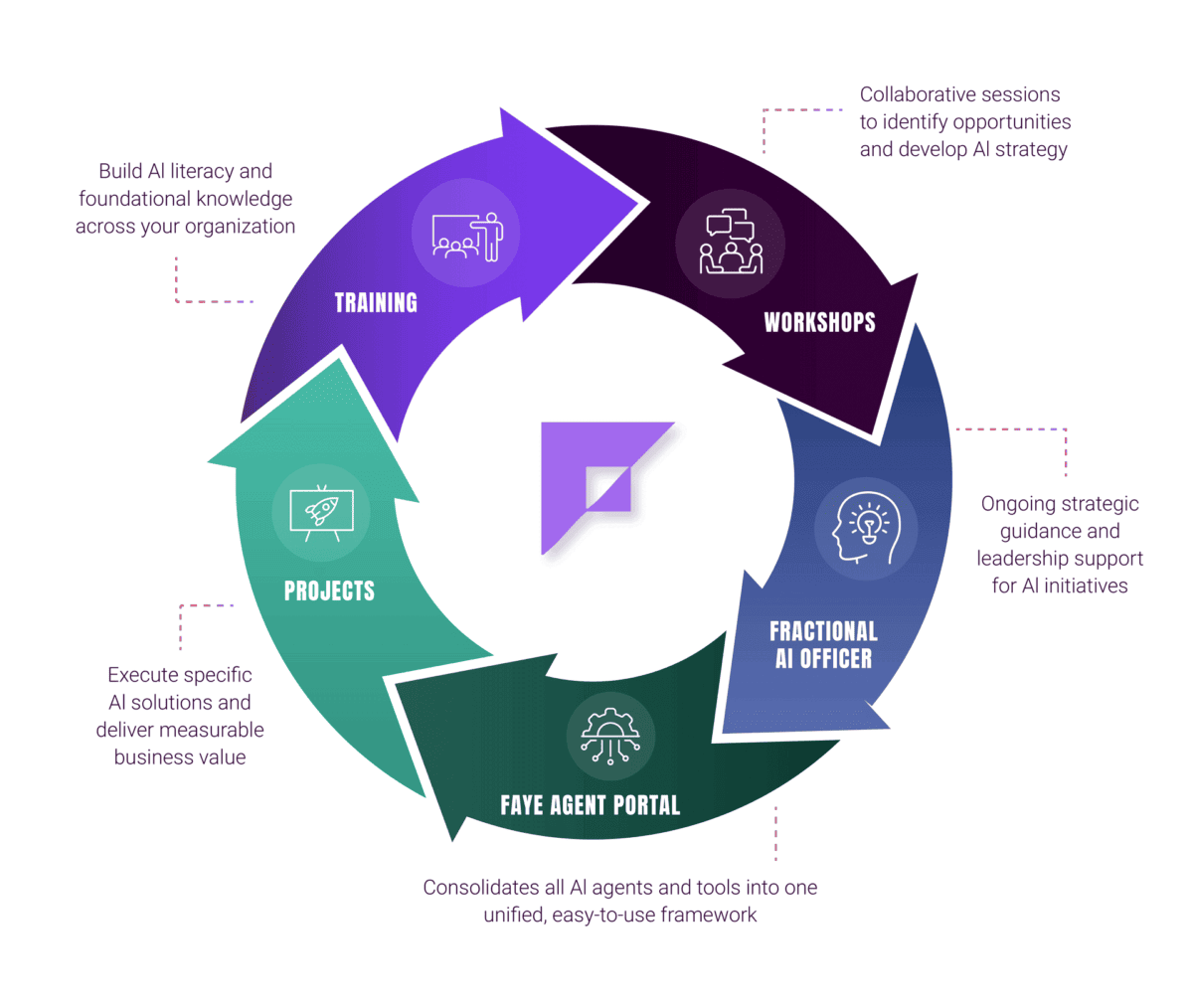
The AI Journey: What a Strong AI Consulting Partner Actually Does
Successful AI adoption rarely happens through a single project or tool deployment. Organizations that see lasting value approach AI as a journey, one that unfolds over time and requires the right sequencing of education, strategy, execution, and support.
A strong AI consulting partner begins by understanding where an organization currently sits on that journey. From there, they guide teams through a structured process designed to ensure AI initiatives are aligned with real business needs and existing systems.
Step 1: Education and AI Training
Effective artificial intelligence consulting starts with education. Before deploying tools or building AI systems, teams need a clear understanding of what AI can do, what it cannot do, and where potential risks exist. AI training helps employees and leaders develop realistic expectations, understand responsible usage, and recognize opportunities where AI can add value without introducing unnecessary risk.
Step 2: Workshops to Identify High-Impact Use Cases
Once teams share a foundational understanding, strong partners facilitate workshops to uncover where AI can make the biggest difference. These sessions focus on examining current business processes, identifying inefficiencies, and highlighting areas of repetitive or manual work. Rather than chasing novelty, this step ensures AI solutions are tied to meaningful, high-impact opportunities.
Step 3: Building and Integrating AI Systems
Only after clarity is established do the best AI consulting companies move into execution. This may involve AI development, gen AI implementations, or the creation of agents and automations. At this stage, integration is critical. AI systems must work seamlessly with existing platforms, data sources, and workflows to be usable and scalable.
Step 4: Ongoing Support and Continuous Improvement
AI initiatives do not end at deployment. Data changes, processes evolve, and business priorities shift. Strong AI consulting firms provide ongoing support to monitor performance, refine models, and adjust systems over time. This continuous approach ensures AI integration remains effective and aligned with long-term business growth rather than becoming outdated or underused.
Measuring Success: Quick Wins vs. Long-Term AI Strategy
Success in AI adoption is often measured by how quickly results appear. While early momentum matters, organizations see the greatest impact when they balance short-term wins with a clear long-term strategy. Strong AI consulting firms help organizations manage both without sacrificing one for the other.
Quick Wins: Building Momentum Through Focused Use Cases
Quick wins play an important role in artificial intelligence consulting engagements. Rather than deploying AI across the entire organization, effective partners focus on a single department or workflow where results can be measured quickly.
Common examples of quick wins include:
- Automating repetitive administrative tasks to improve operational efficiency
- Using AI solutions to summarize customer interactions or support tickets
- Assisting sales or service teams with faster data retrieval and response drafting
- Reducing manual handoffs within specific business processes
These focused initiatives help teams build confidence, demonstrate value, and create alignment without overwhelming the organization or introducing unnecessary risk.
Long-Term Strategy: Scaling AI Responsibly
While quick wins generate momentum, sustainable success requires a broader strategy. Strong AI consulting companies help organizations plan how early initiatives will scale across systems, teams, and data environments over time.
Long-term strategy considerations often include:
- Integrating AI into core platforms such as CRM, CX, or operational systems
- Establishing standards for data quality, access, and governance
- Expanding AI capabilities across additional business functions
- Aligning AI initiatives with long-term business objectives and growth plans
- Ensuring ongoing monitoring, refinement, and support as systems evolve
The best AI consulting firms think beyond pilots. By connecting early wins to a deliberate roadmap, they help organizations avoid stalled projects and ensure AI continues to drive meaningful business growth over the long term.
Closing Thoughts: Choosing the Right AI Consulting Partner
Selecting the right AI consulting partner is less about finding the fastest path to deployment and more about choosing a firm that understands how AI fits into the broader business. The best AI consulting firms help organizations slow down at the right moments, ask better questions, and apply AI in ways that support real workflows.
AI adoption works best when it is treated as a journey that balances education, experimentation, execution, and ongoing refinement. Organizations that take this approach are better positioned.
For organizations looking to explore AI with structure and clarity, working with a partner with deep expertise can make the difference. If this way of thinking about AI consulting resonates, Faye’s AI Services are designed to help organizations move forward deliberately.
Click Here To See The Full Range Of AI Services We Offer


Many organizations are reassessing how voice-based interactions are handled at scale. Advances in voice AI and AI voice agents have Read more

At first glance, AI agents vs custom GPTs sounds like a technical debate. But for most organizations, it’s actually a Read more

Artificial intelligence (AI) is reshaping how organizations operate. As AI technology becomes more deeply embedded into everyday business operations, companies Read more

For years, chatbots were seen as the future of customer interaction. But as technology has advanced, traditional chatbots have begun Read more